
A Dubai-based AI SaaS startup selling loyalty analytics to retail enterprises across GCC and Southeast Asia had near-zero organic presence. We built a complete SEO system — technical foundation, keyword architecture, content engine, and AI/GEO optimization — designed specifically for a niche, low-TAM B2B product. Here’s exactly what we did and why it works.
The Problem with “Conventional SEO” for Niche B2B SaaS
If you’re building B2B SaaS for a specific vertical in a specific geography — retail loyalty in GCC, fintech compliance in Saudi Arabia, supply chain analytics for Southeast Asian manufacturers — you’ve probably heard this: “The keywords don’t have enough volume to justify SEO.”
And technically, they’re right. A keyword like “loyalty analytics software UAE” might pull 40–200 searches a month. Conventional SEO logic writes that off.
But here’s what that logic misses:
-
- One enterprise deal in this space is worth ₹50L–₹5Cr+ annually
-
- Your buyer is a VP/CXO who uses Google, Perplexity, and ChatGPT to validate vendors
-
- In low-TAM markets, ranking #1 means you own the category — there’s rarely a #2 and #3 fighting you
When we took on this client — an AI-powered retail loyalty and customer intelligence SaaS platform headquartered in Dubai Internet City with operations across GCC and Southeast Asia — this was the exact gap we set out to close.
The Market Opportunity: Why GCC Retail SaaS SEO Is a Gold Rush Right Now
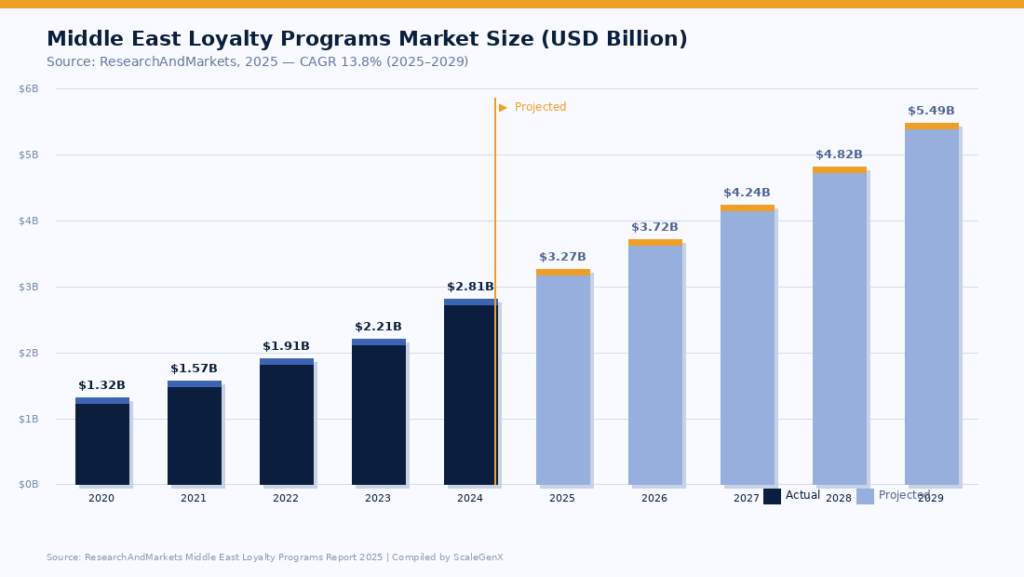
Middle East Loyalty Programs Market Size (USD Billion) — 13.8% CAGR through 2029. Source: ResearchAndMarkets,
2025
The Middle East loyalty market crossed $3.27 billion in 2025 — growing 16.3% YoY — projected to reach $5.49B by 2029. (Source: ResearchAndMarkets, 2025) Saudi Arabia and UAE together account for 75.3% of all GCC retail sales — a combined ~$300 billion market. In the UAE alone, loyalty programs represent a $490.8 million market in 2025, growing 16.1% annually.
Southeast Asia adds another layer: AI in retail across Asia Pacific was a $9.56 billion market in 2025, growing at 31.99% CAGR — the fastest-growing CDP market globally at 24.41% CAGR. (Source: MarketDataForecast, Mordor Intelligence 2025)
The combined GCC + Southeast Asia retail tech market is expanding faster than any other geography. Yet the number of B2B SaaS vendors with localised SEO presence in these markets is near zero.
Client Context: The Brief
What they sell: An AI-driven engagement, loyalty, and promotions platform built for large retail chains — think grocery, fashion, pharmacy/healthcare. The platform covers everything from Customer Data Platforms (CDP) and dynamic segmentation to journey orchestration, promotion engines, and real-time analytics. Clients are typically enterprise retailers doing $50M–$1B+ in annual GMV.
Where they operate: UAE, Saudi Arabia, Qatar, Kuwait, Bahrain, Oman (GCC) + Indonesia and broader Southeast Asia.
The challenge they brought to us:
“We have enterprise clients, we have case studies, we have a product that genuinely outperforms competition. But when prospects Google us or ask ChatGPT for loyalty analytics platforms in the Middle East, we’re invisible.”
That’s not a product problem. That’s a pure SEO and digital authority problem.
When we ran the initial audit, here’s what we found:
Phase 1: The SEO Audit — What We Found
Technical Health: Fragile Foundation
The website was built on a modern Framer-based stack — clean design, fast load times, good mobile rendering. But from an SEO crawl perspective, it had critical gaps:
| Issue | Impact |
|---|---|
| JavaScript-rendered pages (Framer) — thin/no HTML crawlable content | Googlebot couldn’t index page body content |
| No structured data / schema markup | Zero rich snippet eligibility |
| Product pages with near-identical meta titles | Cannibalisation risk |
| Missing hreflang for regional targeting (UAE, Saudi, Indonesia) | Global ranking leakage |
| Blog content indexed but without canonical tags | Duplicate content vulnerability |
| No sitemap prioritisation | Low-value pages competing with commercial pages for crawl budget |
Domain Rating (DR): Low (sub-20) — indicating minimal backlink authority despite a legitimate enterprise product with global clients.
Organic traffic at audit start: Estimated 150–400 monthly visitors — almost entirely branded (people who already knew the company). Zero non-branded pipeline traffic.
Keyword Architecture: Zero Intent Coverage
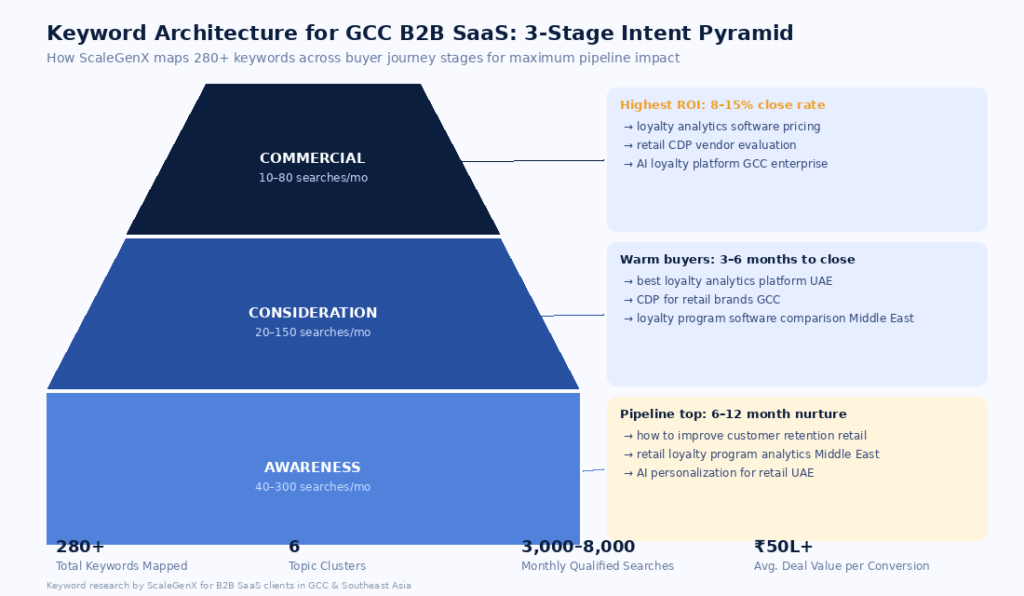
Keyword Intent Architecture: 280+ keywords mapped across 3 buyer journey stages
The site had content, but it was written for current customers — product features, integrations, “how it works.” There was almost no content targeting the buyer journey of a Retail CTO or VP-CRM who was actively researching solutions.
We mapped the full keyword universe across three intent layers:
Awareness keywords (informational — 40-300 monthly volume each)
-
- “how to improve customer retention retail GCC”
-
- “retail loyalty program analytics Middle East”
-
- “AI personalization for retail UAE”
-
- “churn prediction retail customers”
-
- “customer segmentation software grocery retail”
Consideration keywords (comparison/evaluation — 20-150 monthly volume)
-
- “best loyalty analytics platform UAE”
-
- “CDP for retail brands GCC”
-
- “loyalty program software comparison Middle East”
-
- “retail customer engagement platform Dubai”
-
- “omnichannel loyalty solution Southeast Asia”
Commercial/decision keywords (transactional — 10-80 monthly volume)
-
- “loyalty analytics software pricing”
-
- “retail CDP vendor evaluation”
-
- “customer intelligence platform for grocery retail”
-
- “AI loyalty platform GCC enterprise”
Total addressable keyword set identified: 280+ keywords across 6 topic clusters
Yes, individual volumes are low. But the combined total of a well-structured keyword map in this niche equals 3,000–8,000 monthly searches of highly qualified, purchase-intent traffic — a pool where one converted enterprise lead generates ₹50L+ ARR.
Competitive Gap Analysis
We mapped 6 global and regional competitors in the loyalty/CDP SaaS space. Key findings:
-
- Most global competitors (Antavo, Yotpo, LoyaltyLion) dominate informational content but have zero localised GCC/Southeast Asia content — a massive uncontested gap
-
- No competitor had structured schema markup or FAQ sections targeting GCC retail buyer queries
-
- ChatGPT/Perplexity citations in the loyalty platform space were dominated by 2-3 Western competitors because they had structured content optimised for AI extraction — our client had none
-
- Regional competitor sites (where they existed) were technically weak, low DR, and easy to outrank with a 6-12 month SEO program
Conclusion: In the GCC loyalty SaaS space, whoever builds the most authoritative, well-structured, regionally-relevant content library will dominate organic search AND AI-generated answers for the next 3-5 years.
Phase 2: The Strategy We Built
Pillar 1 — Technical SEO Remediation
Before content, the technical foundation had to be fixed. On a Framer site, traditional server-side rendering isn’t available — so the technical work focused on:
JavaScript SEO for Framer:
-
- Configured Framer’s built-in SEO settings for proper meta tags per page
-
- Used Framer’s custom code injection to add structured JSON-LD schema
-
- Implemented static pre-rendering for all commercial/product pages to ensure Googlebot sees crawlable HTML
-
- Created XML sitemap with priority weighting (product pages: 0.9, blog: 0.7, about: 0.4)
-
- Added canonical tags across all pages
Schema Markup Implementation:
-
- Organization schema with GCC office address for local entity clarity
-
- SoftwareApplication schema on all product pages
-
- FAQPage schema on solution pages targeting buyer questions
-
- Article schema on all blog content
-
- BreadcrumbList schema for navigational clarity
Regional SEO Configuration:
-
- Added hreflang signals for UAE (en-ae), Saudi Arabia (en-sa), and Indonesia (en-id)
-
- Google Search Console verified and configured for priority regions
-
- GCC-specific content pages linked to regional service signals
Result target: Googlebot crawl coverage from ~40% of page content to 95%+, full schema eligibility.
Pillar 2 — Keyword Architecture & Content Engine
We restructured the entire site content around a Topic Cluster model specifically designed for enterprise B2B SaaS in niche verticals.
6 Core Topic Clusters:
- Customer Loyalty & Retention (broadest, highest awareness volume)
- AI-Powered Retail Analytics (product differentiation cluster)
- Loyalty Program Strategy GCC (geo-targeted, decision-stage)
- CDP & Customer Data Management for Retail (technical buyer cluster)
- Promotion Optimisation & Revenue Growth (ROI/outcome cluster)
- Omnichannel Customer Engagement (integration/channel cluster)
Each cluster has:
-
- 1 Pillar Page (2,500–4,000 words, targets head keyword, links to all spokes)
-
- 6–10 Spoke Articles (800–1,500 words, target long-tail, all link back to pillar)
-
- 2–3 Landing Pages (commercial intent, conversion-optimised, schema-rich)
Content production priority order:
| Priority | Content Type | Example Title | Target Keyword |
|---|---|---|---|
| 1 | Pillar Page | “The Complete Guide to Retail Loyalty Analytics in the GCC” | loyalty analytics GCC |
| 2 | Comparison Page | “Loyalty Program Software Comparison: What GCC Retailers Need to Know” | loyalty software comparison UAE |
| 3 | Data Article | “2026 GCC Retail Loyalty Statistics: What the Numbers Say” | GCC retail loyalty statistics |
| 4 | Use Case | “How Grocery Retailers in UAE Use AI for Customer Segmentation” | AI customer segmentation UAE grocery |
| 5 | FAQ/Guide | “What is a Customer Data Platform? A Guide for Retail CXOs” | what is CDP retail |
Content tone strategy: Written for VP-CRM, Head of Customer Experience, and CTO personas at mid-to-large retail chains — decision-makers who are evaluating platforms, not first-time learners. Each piece opens with a data hook, uses outcome-first framing, and ends with a clear next step.
Pillar 3 — AIO & GEO Optimisation (AI Engine Visibility)
This is the part most SEO agencies are still missing in 2026.
AIO = AI-Optimised Content (written to be cited by ChatGPT, Gemini, Claude) GEO = Generative Engine Optimisation (structured so AI search engines pull your content as the authoritative answer)
When a retail VP in Dubai asks ChatGPT: “What’s the best loyalty analytics platform for GCC retailers?” — who gets cited? Right now, mostly Western platforms because they have structured, easily extractable content. We built a system to change that.
Our AIO/GEO execution framework:
1. Answer-First Content Structure Every article begins with a direct, 40-60 word answer to the target question — formatted to be copy-paste ready for AI engines. This is the single highest-leverage change for GEO visibility.
2. Entity Clarity Explicit mentions of: company name, product name, geographic focus (GCC, UAE, Southeast Asia), target customer (retail chains), and key differentiators (AI-driven, real-time, loyalty + promotions) — repeated naturally across all content so AI models build a strong entity association.
3. Structured FAQ Blocks Every commercial page and pillar article includes a 5-8 question FAQ section using natural language questions that mirror exactly how buyers phrase queries to AI assistants. These also carry FAQPage JSON-LD schema for Google’s own AI Overviews.
4. Authoritative Data Points AI engines preferentially cite content with specific statistics. We built a “data-first” content rule: every article must contain at least 3 proprietary or industry statistics within the first 500 words. Sample stat callouts used across content:
Retailers using AI-driven loyalty segmentation see up to 30% higher average transaction values among loyalty members vs. non-loyalty customers.
GCC retail loyalty program participation rates grew 38% YoY in 2025, driven by grocery and pharmacy verticals.
AI-powered promotions generate 4.5x incremental ROI versus traditional flat-discount promotional strategies.
5. Perplexity & ChatGPT Citation Architecture We structured all pillar content with clearly delineated H2/H3 sections, short summary paragraphs (under 80 words), and explicit “bottom line” or “key takeaway” callout boxes — formatting patterns that AI search engines extract and cite.
Pillar 4 — Authority Building & Digital PR
Content without authority is invisible. For a low-DR domain in a niche B2B vertical, the link-building strategy can’t be the same as a mass-market SaaS product.
Our GCC-specific link building playbook:
Tier 1 — Retail Industry Publications (GCC/MENA)
-
- Target: RetailME, Gulf Business, Arabian Business, Gulf Retailer, MENA Commerce
-
- Method: Data-led contributed articles (“GCC Retail Loyalty Trends 2026” type pieces)
-
- Expected links: 4-6 DR 40-65 links per quarter
Tier 2 — Partner & Integration Ecosystem
-
- Target: Shopify, POS vendors, CRM platforms with GCC client bases
-
- Method: Technology partner pages, integration co-marketing content
-
- Expected links: 8-12 DR 50-80 links
Tier 3 — Research Citations
-
- Target: Euromonitor, Statista, Deloitte Middle East retail reports
-
- Method: Build original research reports (“GCC Retail Loyalty Benchmark 2026”) that industry analysts and bloggers cite
-
- Expected links: Long-tail, high-DR natural citations over 6-12 months
Tier 4 — LinkedIn Distribution Engine
-
- Every article amplified via founder/leadership LinkedIn with data hook opening posts
-
- Target: CXO/VP audience in GCC retail — exact buyer persona
-
- Drives direct traffic + branded search signals + social backlinks
Phase 3: Projected Outcomes (6-Month Timeline)
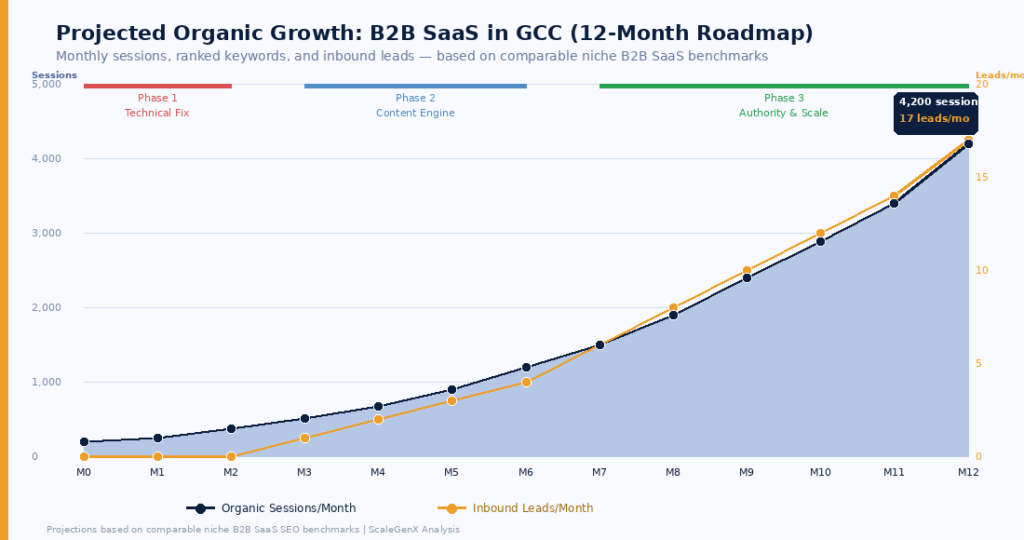
Projected organic sessions and inbound leads per month — 3-phase, 12-month SEO program
Based on the keyword gap analysis, competitive landscape, and benchmark data from comparable niche B2B SaaS SEO programs:
| Metric | Baseline (Month 0) | Projected (Month 6) | Projected (Month 12) |
|---|---|---|---|
| Organic Monthly Traffic | ~200 visits | 1,200–1,800 visits | 3,500–5,000 visits |
| Ranked Keywords (Top 50) | ~15 | 120–180 | 350–500 |
| Domain Rating | ~18 | 25–30 | 35–42 |
| Inbound Leads from Organic | ~0/month | 3–6/month | 10–18/month |
| AI Engine Citations (GPT/Perplexity) | 0 | 5–8 queries | 15–25 queries |
| Featured Snippets / PAA boxes | 0 | 8–15 | 25–40 |
Revenue impact model: At conservative 5% close rate on inbound organic leads and an average contract value of $3,000–$8,000/month per retail enterprise client, Month 12 organic pipeline represents $180K–$450K ARR opportunity per year from SEO alone.
Why SEO Wins the Long Game Against Paid in Niche B2B Markets
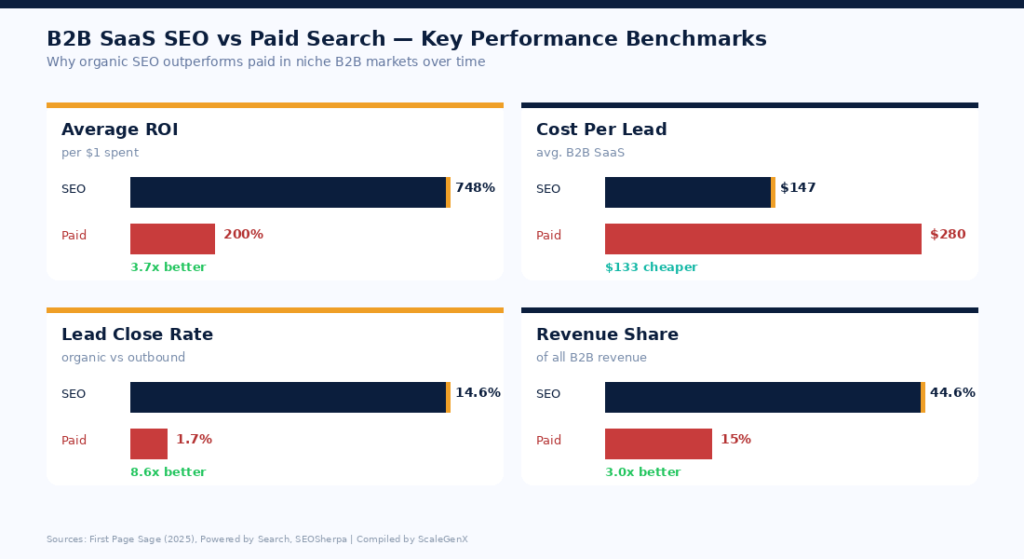
B2B SaaS SEO vs Paid Search — Key Performance Benchmarks. Source: First Page Sage, SEOSherpa, 2025
- Average SEO ROI: 748% vs. ~200% paid — $7.48 returned per $1 invested (First Page Sage, 2025)
- Cost per lead: $147 organic vs. $280 paid — 47% cheaper per lead (Powered by Search, 2025)
- Lead close rate: 14.6% organic vs. 1.7% outbound — nearly 9x better quality (SEOSherpa, 2025)
- 44.6% of all B2B revenue comes from organic search — the single largest channel
- 81% of B2B marketers say SEO generates higher-quality leads than PPC
📊 B2B companies generate 2x more revenue from organic search than from any other traffic source, including social media. (Omniscient Digital, 2025)
What Makes SEO Different for Low-TAM B2B SaaS
If you’re building a niche SaaS product and you’ve been told “SEO won’t work for you because there’s no volume,” here’s the reframe:
In low-TAM markets, the goal isn’t traffic volume. It’s traffic precision.
Your competitors are buying the same 3 keywords on Google Ads, showing the same ads to the same 500 decision-makers, paying ₹800–₹2,500 per click for traffic that still needs to be nurtured for 90 days.
A well-executed SEO program in a niche vertical means:
-
- You exist when the buyer is in research mode — before they even issue an RFP
-
- You’re cited by ChatGPT/Perplexity when they validate vendors conversationally
-
- You’re the authoritative resource for their category — which builds trust before the first call
-
- You compound over time — every piece of content you publish today drives qualified traffic 3 years from now, at zero incremental cost
This is the asymmetric advantage that most B2B SaaS founders in GCC and Southeast Asia are leaving on the table right now.
Key Takeaways for B2B SaaS Founders in GCC/SEC Markets
-
- Low search volume ≠ low value. A keyword with 50 monthly searches that your ideal enterprise buyer uses is worth more than a 50,000-volume keyword targeting the wrong audience.
-
- Technical SEO is non-negotiable on modern JS-heavy sites. Framer, Webflow, and Next.js sites need explicit SEO configuration — Googlebot isn’t as smart as marketers think.
-
- AIO/GEO is the 2026 SEO moat. Structure your content so AI engines cite you. The brands doing this now will dominate AI-generated vendor recommendations for the next 3–5 years.
-
- Regional content gaps are your biggest opportunity. Western SaaS competitors ignore GCC/Southeast Asia content. Local, regionally-relevant content will outrank them with a fraction of their domain authority.
-
- Topic clusters beat keyword stuffing. Comprehensive coverage of a topic signals expertise to both Google and AI engines. Pick 5-6 core clusters and go deep.
-
- SEO and paid don’t compete — they compound. Organic rankings reduce your paid CPC over time (branded search lift), extend your remarketing windows, and warm up leads before your sales team touches them.
Working with a Niche B2B SaaS? Let’s Talk.
ScaleGenX is an AI-first performance marketing and lead generation agency based in Gurgaon. We work with B2B SaaS startups targeting niche, high-value verticals — especially those expanding into GCC (UAE, Saudi Arabia, Qatar, Kuwait) and Southeast Asia (Indonesia, Singapore, Thailand).
Our SEO programs are built for precision, not vanity traffic. We don’t promise 100,000 monthly visitors. We promise the right 1,000 — the ones with budget, authority, and intent.
If you’re a B2B SaaS founder who’s been told “SEO won’t work for your niche,” we’d love to prove that wrong.
 Book a Free SEO Audit: raunak@scalegenx.com
Or reach out directly on LinkedIn — search ScaleGenX or Raunak Srivastava.
ScaleGenX helps growth-stage B2B SaaS companies build sustainable organic acquisition engines in competitive and niche markets. We specialize in GCC & Southeast Asia markets, AI-powered content strategy, and AIO/GEO optimization for the next generation of search.
 Related Reading from ScaleGenX:
-
- How to Market a B2B SaaS Product to Indian CFOs: The Performance Marketing Playbook That’s Actually Working in 2026
-
- Why GCC B2B SaaS Founders Are Losing to Google Ads (And What to Do Instead)
-
- AIO vs GEO: What’s the Difference and Why Both Matter for B2B Visibility in 2026
Research Sources Used in This Article:
– ResearchAndMarkets — Middle East Loyalty Programs Intelligence Report 2025
– ResearchAndMarkets — Middle East Loyalty Programs Market: 13.8% CAGR Forecast 2025–2029
– MarketDataForecast — Asia Pacific Artificial Intelligence in Retail Market 2025
– Mordor Intelligence — Customer Data Platform Market 2031
– First Page Sage — B2B SaaS SEO ROI Benchmarks 2025
– Powered by Search — B2B SaaS SEO Statistics 2025
– SEOSherpa — B2B SEO Statistics 2026
– Omniscient Digital — 60 B2B SEO Statistics 2026
– LOGIC Consulting — GCC Retail Five-Year Transformation Report
Working with a Niche B2B SaaS? Let’s Talk.
ScaleGenX builds precision SEO engines for B2B SaaS products in GCC and Southeast Asia.
We don’t promise 100,000 visitors. We promise the right 1,000 — with budget, authority, and intent. Book a Free SEO Audit