
Quick take: The best Indian B2B SaaS companies in finance and expense automation aren’t winning because of better features. They’re winning because they’ve figured out a very specific buyer journey — and they show up at every stage of it. This is the exact channel playbook that drives predictable pipeline for Indian SaaS targeting CFOs, Finance Heads, and Founders at 50–500 person companies.
What Is B2B SaaS Performance Marketing — and Why Does It Work Differently in India?
B2B SaaS performance marketing in India is a multi-channel demand generation system that targets high-intent decision-makers — typically CFOs, Finance Heads, and Founders at Indian SMEs — across Google Search, LinkedIn, and SEO/content, with each channel playing a defined role in a coordinated funnel that turns strangers into sales-qualified leads.
The key word there is “coordinated.” Most Indian SaaS companies treat their channels in isolation — a Google campaign here, a LinkedIn post there, a blog no one reads. That’s not a system. That’s hope.
What actually works is different. And the companies running it are building 3–6x LTV:CAC ratios while their competitors are still figuring out why their ₹1.5L monthly ad spend generates eight enquiries.
This blog breaks down exactly how it works — channel by channel, stage by stage, with the actual benchmarks.
The Market Window (and Why the Marketing Gap Is Now Bigger Than the Product Gap)
The Indian B2B SaaS opportunity in finance and expense automation is not a secret. 63 million+ Indian SMEs (MSME Ministry, 2024). 88% still tracking expenses manually (NASSCOM, 2024). A ₹7.1 billion enterprise SaaS market by 2026 (NASSCOM). Search interest in “expense management software India” has grown 3× since 2020 (Google Trends).
Everyone building in this space knows the TAM. The problem is they assume great product + great TAM = inbound customers. That math hasn’t worked since 2019.
Here’s what changed: the product gap between Indian SaaS tools has narrowed dramatically. Tally integration works. Mobile approvals work. GST-compliant OCR works. What hasn’t closed is the marketing gap — the gap between companies who can get found, trusted, and considered by the right buyer, and companies who can’t.
The companies winning in Indian B2B SaaS right now aren’t winning on features. They’re winning because their marketing system works harder than their competitors’ at every stage of a buyer journey that most founders have never mapped properly.
The Indian CFO Buyer Journey: What’s Actually Happening Before They Fill Your Demo Form
This is the part most B2B SaaS founders get wrong — and it’s the most important thing to understand before spending a single rupee on ads.
81% of B2B buyers already have a preferred vendor before they ever speak to a sales rep (Wynter Research, 2024). Let that sink in. By the time someone fills your demo form, they’ve usually already decided who they’re going to go with. Your job isn’t to convince them in the demo — your job is to be the company they’re thinking of before they start evaluating.
The buying journey for a CFO at a 100–300 person Indian company looks something like this:
Stage 1 — Problem Awareness (Months 1–4) Something goes wrong. A miscellaneous line item that nobody can explain. A reconciliation that takes four days. An auditor who asks a question nobody can answer cleanly. The CFO Googles the problem, not the solution. Searches like: “how to reduce petty cash leakage”, “manual expense tracking problems India”, “why finance reconciliation takes too long”. This is where content ranks. This is where trust begins.
Stage 2 — Category Research (Weeks 1–3 of active search) They’ve identified that software might fix it. Now they’re researching the category. Searches shift: “expense management software India”, “best Tally-integrated expense tools”, “petty cash automation SME”. Google Ads at commercial intent terms start mattering here. So does your SEO. So does your LinkedIn presence — because they’ll look you up on LinkedIn the same week.
Stage 3 — Vendor Shortlisting (1–2 weeks) The average B2B purchase now involves 13 stakeholders (Forrester, 2024). The CFO is building a shortlist to present to the MD or board. They’re reading case studies, checking LinkedIn for social proof, watching demos on YouTube, and asking their network. The companies they shortlist are the ones they’ve seen multiple times across multiple channels. You don’t make the shortlist by appearing once.
Stage 4 — Demo & Decision They fill a demo form. The actual conversation is almost a formality at this point — the trust was built in Stages 1 through 3.
What This Means for Your Channel Strategy
|
Buyer Stage |
What They’re Doing |
Channel That Wins |
|---|---|---|
|
Problem awareness |
Googling symptoms, not solutions |
SEO / Content |
|
Category research |
Comparing software options |
Google Ads (commercial intent) + Content |
|
Vendor shortlisting |
Checking LinkedIn, reading case studies |
LinkedIn + Retargeting |
|
Demo request |
High intent, near-decision |
Google Ads (transactional) + Demo page CRO |
Each stage requires a different message and a different channel. Running one channel for all stages is why most Indian B2B SaaS Google Ads campaigns have a CPL of ₹8,000–₹15,000.
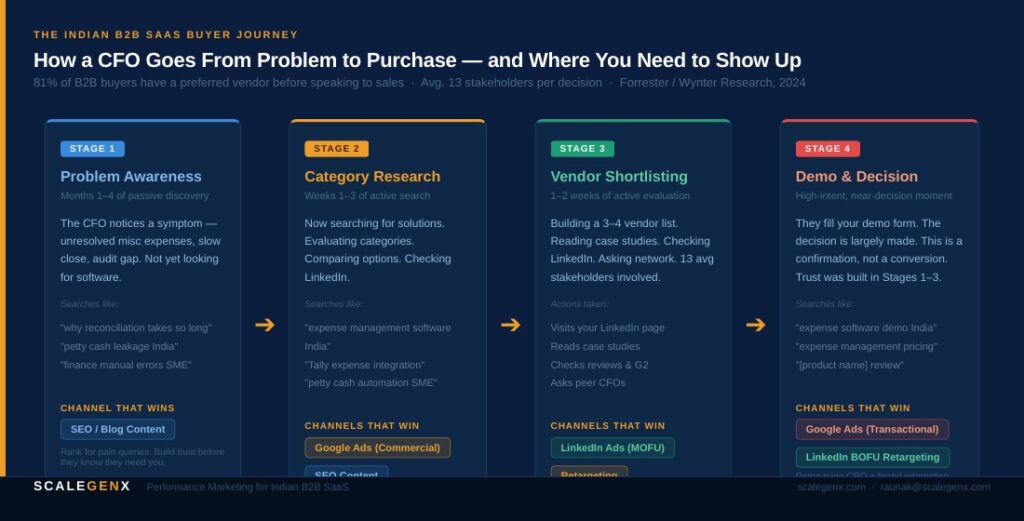
Buyer Journey Channel Map]
Horizontal timeline showing the 4 buyer stages, with channels (Content/SEO, Google Ads, LinkedIn, Retargeting) mapped to each stage with brief role descriptions. Clean dark navy brand treatment.
The 3-Channel System: What Actually Drives Pipeline for Indian B2B SaaS
There are three channels that, when run together as a coordinated system, produce predictable pipeline for Indian B2B SaaS companies targeting finance decision-makers. Each has a specific role. None of them work optimally in isolation.
Channel 1 — Google Search: Capturing the Buyer Who’s Already Looking Bottom-of-funnel demand capture. These buyers have the problem, know they need software, and are actively searching. The highest-intent traffic available. The challenge is getting the keyword strategy and landing page right.
Channel 2 — LinkedIn: Building the Pipeline Before the Buyer Is Ready 95% of your target buyers are not in-market right now. They will be in 3–18 months. LinkedIn is how you become the brand they think of when that moment arrives. Top and mid-funnel demand generation. Slower to pay out, but builds compounding pipeline.
Channel 3 — Content & SEO: The Channel That Pays You Back for Years The only channel where CAC goes down over time. A well-ranked article on a CFO pain point generates inbound leads every month at near-zero marginal cost. Takes 6–12 months to build, but becomes your best-performing channel by Month 18.
 The insight most Indian SaaS founders miss: These three channels are not interchangeable. Trying to use Google Ads for brand building, or expecting LinkedIn to generate immediate purchase intent, or waiting for SEO to replace paid media — these are the decisions that make entire marketing budgets disappear without results.
Channel 1 Deep Dive: Google Search Strategy for Indian B2B SaaS
Intent Tiers — The Only Framework You Need
Not all Google searches are equal. A CFO searching “what is petty cash” is not the same as a CFO searching “petty cash automation software price India.” Running the same ad for both keywords is one of the most common — and expensive — mistakes in B2B SaaS Google Ads.
There are three keyword intent tiers that matter for Indian B2B SaaS:
Google Ads Keyword Intent Map for Indian B2B Finance SaaS
|
Intent Tier |
Example Keywords (India) |
Avg CPC (₹) |
Expected CVR |
Role in Funnel |
|---|---|---|---|---|
|
Informational |
“petty cash management India”, “expense tracking SME”, “manual reconciliation problems” |
₹80–250 |
0.5–1.5% |
Content / Brand only. Don’t run conversion campaigns here. |
|
Commercial |
“best expense management software India”, “Tally expense integration”, “petty cash software SME India” |
₹250–600 |
2–4% |
Primary paid search target. Solution-aware buyers. |
|
Transactional |
“expense management software demo India”, “expense tracking software pricing”, “CFO tools India free trial” |
₹500–1,200 |
5–9% |
Highest ROI. Small volume but ready to buy. |
Benchmarks for Indian B2B SaaS finance category. Informational CPCs are low because competition is low — but conversions are near-zero. Most SaaS companies waste 40–60% of their Google budget on informational terms.
The Campaign Structure That Works
The biggest structural mistake: one campaign, all keywords, generic landing page. What actually converts:
Campaign type: Search only (no Display, no broad match on commercial terms)
Match types: Exact and Phrase for commercial + transactional terms. Broad modified (or broad with smart bidding + strong negative lists) for discovery.
Negative keywords: Non-negotiable. Add 200+ negatives before going live. Filter out: “free”, “excel”, “tutorial”, “what is”, job seeker terms, competitor brand names you’re not targeting. Top performers maintain 500+ negatives and review weekly.
Landing page: Each intent tier needs a dedicated page. The commercial-intent page is not your homepage. It’s a page built around the search term — headline matches the keyword, proof points match the objection, CTA matches the stage.
Bidding: Start with Manual CPC to gather data. Shift to Target CPA after 30–50 conversions. Target ROAS once you have 90+ days of revenue data.
India-Specific Benchmark Expectations
Running a well-structured campaign for Indian B2B SaaS finance software, here’s what realistic numbers look like:
|
Metric |
Poor Campaign |
Optimized Campaign |
|---|---|---|
|
Click-Through Rate |
2–3% |
6–10% |
|
Landing Page CVR |
1–2.5% |
4–8% |
|
Cost Per Lead (₹) |
₹8,000–₹18,000 |
₹2,500–₹5,000 |
|
Lead-to-Demo Rate |
10–15% |
25–35% |
|
Cost Per Demo (₹) |
₹50,000+ |
₹8,000–₹20,000 |
The gap between poor and optimized isn’t budget. It’s structure, intent-matching, and landing page quality.
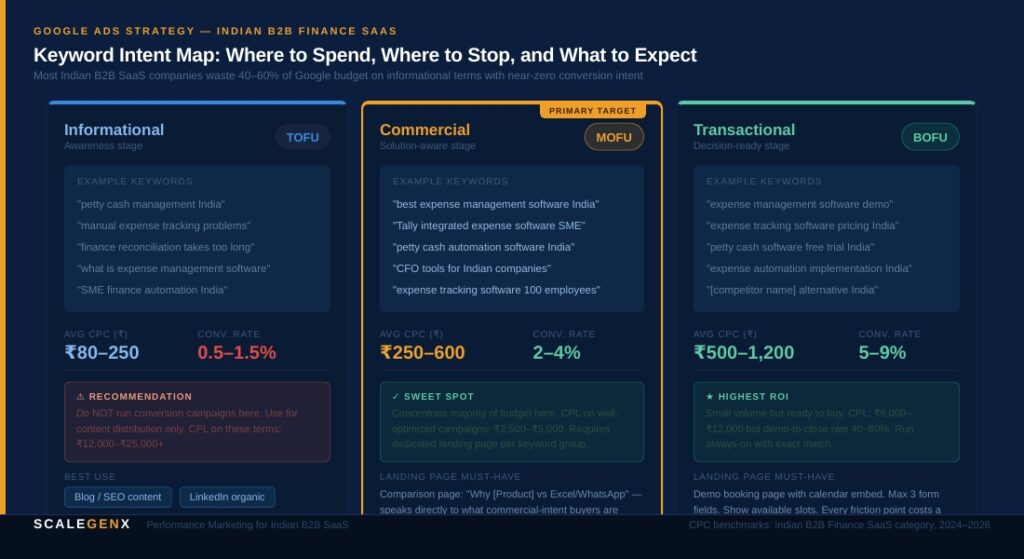
Google Ads Keyword Intent Map Mockup]
Three-column visual: Informational / Commercial / Transactional. Each column shows example keywords, CPC range, CVR, and role in funnel. Clean dashboard-style layout.
Channel 2 Deep Dive: LinkedIn Demand Generation for Indian Finance SaaS
Why LinkedIn Is Non-Negotiable for This Category
LinkedIn has 100 million+ registered users in India (LinkedIn, 2024). 80% of B2B leads generated digitally in India flow through LinkedIn (LinkedIn Business, 2024). And unlike Google, where you’re chasing buyers who already have intent — LinkedIn lets you build intent in your exact ICP before they ever search.
For Indian B2B SaaS targeting CFOs and Finance Heads at 50–500 person companies, there is no better channel for building a pipeline of future buyers.
Targeting Architecture
The precision of LinkedIn targeting is what makes it work for this category. Here’s the layering structure that produces the best results:
Layer 1 — Job Function: Finance + Accounting Layer 2 — Seniority: Director, CXO, VP, Manager (depending on company size) Layer 3 — Job Title (include): CFO, Finance Head, Finance Controller, VP Finance, Finance Manager, Chief Accounts Officer Layer 4 — Company Size: 51–200 employees (early adopter segment) + 201–500 employees (primary sweet spot) Layer 5 — Industry: Manufacturing, Retail & Consumer Goods, Distribution, Professional Services, Healthcare Services (highest expense management pain)
Exclude: Students, job seekers (add “Open to Work” exclusion), competitors, investors.
Matched Audiences: Upload your CRM contact list to exclude existing customers. Build a website visitor retargeting audience from the first 30 days.
The targeting refinement that drops CPL by 30–40%: Add LinkedIn’s “Years of Experience” filter (10+ years) to the CFO/Finance Head targeting. This filters out junior finance roles that pass the title check but aren’t actually decision-makers. Fewer impressions, better-quality leads.
Ad Formats by Funnel Stage
Not every ad format is right for every stage. Running a hard demo offer to cold audiences kills your CPL and leaves money on the table.
LinkedIn Ad Format Guide for Indian B2B Finance SaaS
|
Funnel Stage |
Ad Format |
Objective |
Expected CTR |
CPL (₹) |
|---|---|---|---|---|
|
TOFU (Cold audience) |
Single Image — Industry insight |
Brand awareness |
0.5–0.8% |
N/A (awareness) |
|
TOFU–MOFU |
Document Ad — “CFO Benchmark Guide” |
Lead Gen Form |
0.4–0.7% |
₹1,800–₹4,000 |
|
MOFU (Engaged audience) |
Single Image — Client case study |
Website visit |
0.6–1.0% |
₹3,000–₹6,000 |
|
BOFU (Retargeting) |
Conversation Ad / Lead Gen Form — Demo offer |
Demo request |
1.2–2.5% |
₹4,000–₹8,000 |
|
BOFU |
Video — 60-second product walkthrough |
Video view → retarget |
0.8–1.5% |
₹5,000–₹10,000 |
Lead Gen Forms outperform external landing pages by 5× in conversion rate on LinkedIn (LinkedIn, 2024). For Indian mobile-first audiences, this gap is even wider.
The Creative Mistake That Kills B2B LinkedIn Campaigns in India
Most Indian B2B SaaS companies run LinkedIn ads that start with: “Introducing [Product Name] — the smarter way to manage expenses.”
Nobody clicks that. Nobody shares it. Nobody comments. And LinkedIn’s algorithm buries it.
What performs: Lead with the pain, not the product. Lead with the number, not the name. Lead with the question your buyer is already asking themselves.
 “Our expense management software helps CFOs save time.”
 “Your finance team spent 3 days on month-end reconciliation. Here’s what that’s actually costing you.”
The second version speaks to a specific, known pain. The first version describes a product nobody was looking for.
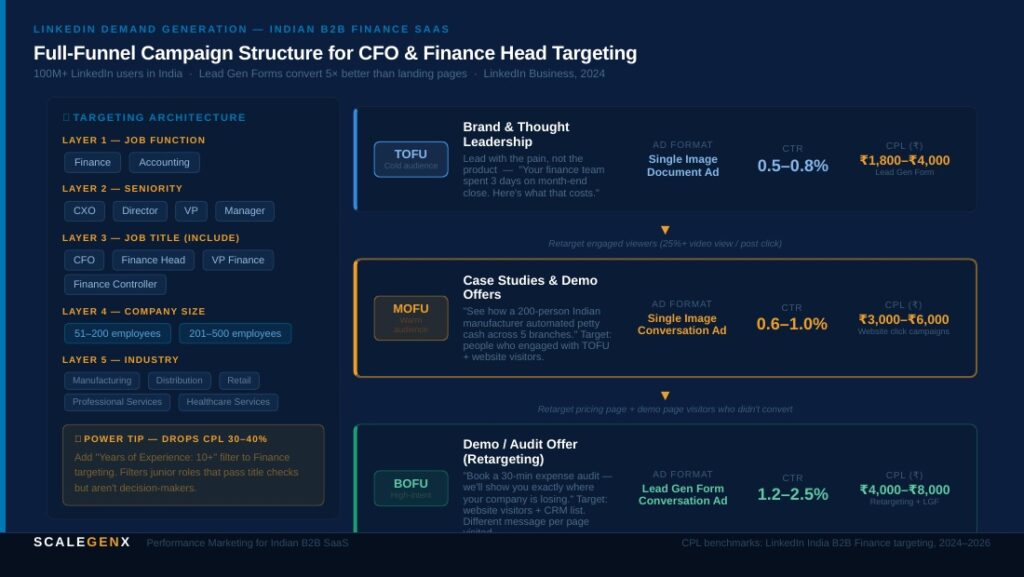
LinkedIn Campaign Structure Diagram]
Visual showing the 3-tier funnel (TOFU/MOFU/BOFU) with audience type, ad format, and message at each stage. Annotated diagram format.
Channel 3 Deep Dive: Content & SEO for the Long Game
The Compounding Channel
Content is the only performance marketing channel where CAC decreases over time. A well-ranked article costs the same to write in Month 1 as it does in Month 24 — but by Month 24, it’s generating 50–200 qualified visitors per month at near-zero marginal cost.
Companies that blog consistently generate 67% more leads per month than those that don’t (HubSpot). For Indian B2B SaaS, the opportunity is even bigger — the category is large, the competition for high-intent keywords is still surprisingly thin, and Google’s AI Overviews are pulling answers directly from well-structured content.
The Content Strategy That Works for Indian B2B Finance SaaS
The mistake: writing product-focused content (“Top 5 Features of Expense Management Software”). Nobody Googles that. Nobody shares it.
What actually drives organic leads: CFO pain-point content — articles written for the exact problems your buyer is typing into Google at 11 PM.
Tier 1 — Problem-Aware Content (Top of Funnel) These rank for informational queries and build brand authority. Examples:
- “Why Indian SME month-end close takes 3–5 days (and how to fix it)”
- “The real cost of petty cash leakage in a 100-person Indian company”
- “Manual expense tracking vs. automation: what Indian CFOs say after switching”
Tier 2 — Solution-Aware Content (Middle of Funnel) These rank for commercial intent queries and capture buyers mid-evaluation. Examples:
- “Expense management software with Tally integration: what to look for in 2025”
- “How Indian manufacturing companies automate petty cash across multiple branches”
- “The B2B SaaS CFO toolkit: what’s in every finance stack at 100–500 person Indian companies”
Tier 3 — Decision-Ready Content (Bottom of Funnel) These rank for high-intent queries and convert directly. Examples:
- “[Product] vs [Competitor]: honest comparison for Indian SMEs”
- “How long does it take to implement expense automation for an Indian SME?”
- “ROI calculator: what expense automation saves a 100-person Indian company”
AIO (AI Overview) Optimization — Why It Matters Right Now
Google’s AI Overviews now appear for 30–40% of commercial and informational searches in India. They pull answers directly from web content — and they favour content that:
- Answers the question directly in the first 1–2 sentences
- Includes a bolded definitional statement in the opening paragraph
- Has structured FAQ sections at the end with direct question-answer format
- Cites credible sources with year
Getting pulled into an AI Overview for a query like “how does expense management software work” or “best B2B SaaS expense tools India” is equivalent to ranking #0 — above every organic result on the page.
Landing Page Architecture: Where Most Indian B2B SaaS Budgets Go to Die
You can have the best Google Ads campaign and the best LinkedIn targeting in your category. If your landing page is wrong, none of it matters.
The average B2B SaaS landing page conversion rate in India is 1.5–2.5%. A well-optimized page for the same traffic converts at 4–8%. That’s the difference between a ₹7,000 CPL and a ₹2,500 CPL — with identical ad spend.
Here’s the anatomy of a high-converting B2B SaaS landing page for Indian finance/expense software:
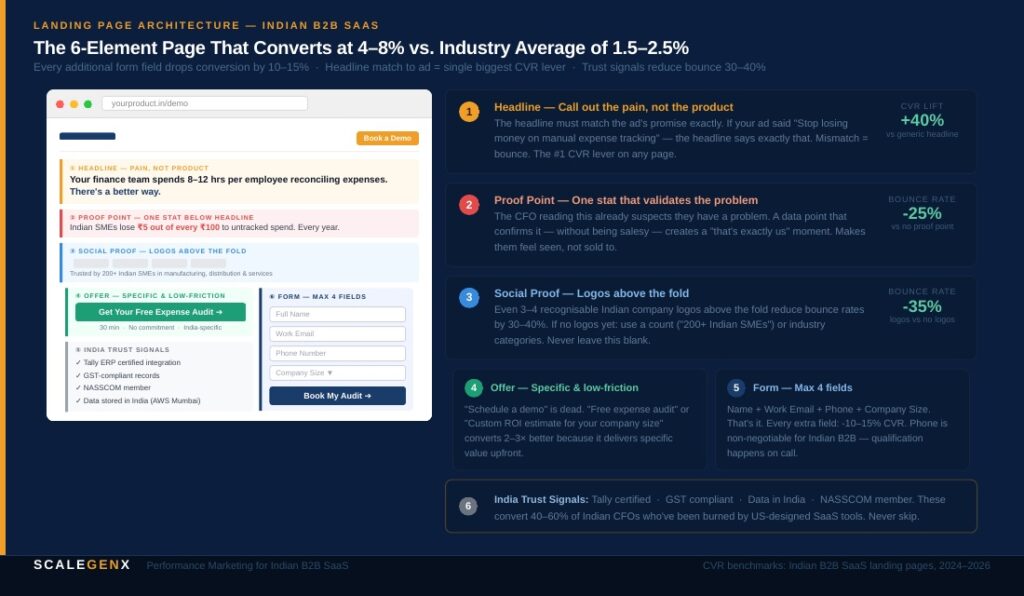
Landing Page Anatomy Mockup] Annotated wireframe mockup of a high-converting B2B SaaS landing page — 6 labelled sections with brief notes on what goes in each. Clean, dark-on-white professional style.
Element 1 — Headline: Call out the pain, not the product “The Smart Expense Management Platform for Growing Businesses” “Your finance team spends 8–12 hours per employee reconciling expenses every month. There’s a better way.”
Element 2 — Proof point: One stat, right below the headline The number that makes the problem undeniable. For expense SaaS: “Indian SMEs lose ₹5 out of every ₹100 to untracked spend. Every year.”
Element 3 — Social proof above the fold Client logos (even 3–4 recognisable Indian company logos) above the fold reduce bounce rates by 30–40%. If you don’t have logos yet, use industry/category recognisability (“Trusted by 200+ Indian SMEs in manufacturing, distribution, and services”).
Element 4 — Offer: Make it specific and low-friction “Schedule a demo” is table stakes. What converts better:
- Free 30-minute expense audit for your business
- Get a custom ROI estimate for your company size
- Watch a 4-minute walkthrough — no signup needed
Element 5 — Form: 3–4 fields maximum Name. Work email. Phone. Company size (dropdown). That’s it. Every additional field drops conversion by 10–15%.
Element 6 — India-specific trust signals GST compliant. Tally-certified integration. Made in India. NASSCOM member. These credibility signals matter enormously for Indian CFOs who have been burned by US-designed SaaS tools that don’t work with Indian financial infrastructure.
The Full-Funnel Numbers: What This System Actually Costs (and Returns)
Enough theory. Here’s what the math looks like when this system runs properly for an Indian B2B SaaS company in the finance automation space:
Full-Funnel Benchmark Model — Indian B2B Finance SaaS (Monthly, for a company targeting 50–500 person Indian businesses)
|
Stage |
Metric |
Conservative |
Optimized |
|---|---|---|---|
|
Google Ads Spend |
— |
₹75,000/mo |
₹75,000/mo |
|
LinkedIn Ads Spend |
— |
₹75,000/mo |
₹75,000/mo |
|
Total Ad Spend |
— |
₹1,50,000/mo |
₹1,50,000/mo |
|
Leads Generated |
Google + LinkedIn |
25–35 |
45–65 |
|
Demo Requests |
20–25% lead→demo |
6–9 |
11–16 |
|
Qualified Demos |
70% of demos |
4–6 |
8–11 |
|
Closed Deals |
25–30% demo→close |
1–2 |
2–3 |
|
Average Contract Value |
Annual |
₹80,000–₹1,50,000 |
₹80,000–₹1,50,000 |
|
Month 1 Revenue |
— |
₹80K–₹3L |
₹1.6L–₹4.5L |
|
CAC |
Spend ÷ Closed Deals |
₹75,000–₹1,50,000 |
₹50,000–₹75,000 |
|
LTV:CAC Ratio |
— |
2.5–3.5x |
4–6x |
|
Payback Period |
— |
8–14 months |
3–6 months |
Methodology: Google Ads at 4% CVR (optimized) vs 2% (conservative). LinkedIn Lead Gen Form CPL at ₹3,500 (optimized) vs ₹6,000 (conservative). ACV ₹1.2L median. Numbers reflect Indian B2B SaaS finance category benchmarks, not global.
The optimized scenario doesn’t require more budget. It requires better structure, better creative, and better landing pages. That’s a methodology gap, not a money gap.
What the Top Performers Do That Others Don’t
After working across enough Indian B2B SaaS companies to see the patterns clearly, four things separate the ones building predictable pipeline from the ones cycling through agencies every six months.
- They measure SQL, not just MQL. Most Indian B2B SaaS companies optimise for leads. Top performers optimise for Sales Qualified Leads — contacts who match the ICP, have the budget, and have a real problem. The shift from lead-volume to lead-quality metrics changes every channel decision downstream.
- They run LinkedIn retargeting against website visitors with a different message. Someone who visited your pricing page but didn’t convert is not the same as someone who visited your blog. Top performers segment website retargeting audiences by page visited and serve different LinkedIn ads to each. Pricing page visitors get a demo offer. Blog readers get a case study. Homepage bouncers get a thought leadership piece.
- They have dedicated landing pages for every major campaign — not the homepage. Homepage bounce rates for B2B SaaS paid traffic average 65–75% in India. Dedicated campaign landing pages built for the specific intent of the ad average 35–45% bounce rate. The difference is message match — the headline on the landing page says exactly what the ad promised.
- They publish 2 high-intent articles per month and distribute them via LinkedIn. Not 10 articles, not daily posts. Two well-researched, well-structured pieces per month — optimised for the queries their buyers are actually searching. Then distributed via the founder’s LinkedIn profile (which reaches a B2B audience organically). This is the lightest-lift, highest-ROI content operation possible.
Frequently Asked Questions
What does performance marketing for Indian B2B SaaS actually include? Performance marketing for Indian B2B SaaS is a multi-channel system that typically includes Google Search Ads (demand capture), LinkedIn Ads (demand generation), SEO and content marketing (organic pipeline), landing page optimisation (conversion), and marketing automation for lead nurturing. Unlike brand marketing, every rupee is tracked to a specific outcome — demo requests, SQLs, and closed revenue.
How much should an Indian B2B SaaS company spend on performance marketing? For a company targeting 50–500 person Indian businesses with an ACV of ₹80,000–₹2,00,000, a starting monthly ad budget of ₹1–1.5L (Google + LinkedIn combined) is sufficient to generate meaningful data and qualified pipeline. The budget should scale with revenue — target 15–25% of monthly revenue reinvested in paid acquisition during the growth phase.
Why doesn’t cold outreach work as well for Indian B2B SaaS anymore? It’s not that cold outreach is dead — it’s that it’s become the default, which means decision-makers are overwhelmed with it. 81% of B2B buyers have a preferred vendor before speaking to sales (Wynter, 2024). Cold outreach primarily works on buyers who have no prior awareness of your brand. Performance marketing builds that awareness first, making every other sales motion — including outreach — dramatically more effective.
What’s the biggest mistake Indian B2B SaaS companies make in their Google Ads campaigns? Running ads on informational-intent keywords with a conversion objective. “What is expense management software” is an informational query — these users are not ready to buy. The highest-returning approach is to concentrate budget on commercial and transactional intent terms (“best expense software India”, “expense management software demo”), which have lower search volume but 3–5× higher conversion rates.
How long does it take to see ROI from a B2B SaaS performance marketing system? Google Search typically shows measurable results (demo requests, CPL data) within 30–45 days if the campaign structure is correct. LinkedIn demand generation takes 60–90 days to build audience warmth and pipeline momentum. SEO takes 6–12 months to produce significant organic leads. The full-system ROI — where all three channels compound — is typically clear by Month 4–6.
Why does LinkedIn work better for Indian B2B SaaS than most founders expect? Because LinkedIn’s targeting is precise in ways Google’s isn’t. You can reach the Finance Head at a 200-person Indian manufacturing company specifically — not just “someone interested in finance.” That precision means even a small budget (₹50,000/month) can generate consistent, qualified pipeline when the creative and offer are right.
If You’re Building a B2B SaaS in This Space, Here’s What We’d Run for You
We’ve built this exact system for Indian B2B SaaS companies in finance automation, expense management, and fintech — and the playbook above is what we run.
Google Search: Intent-tier campaign structure. Separate campaigns for informational, commercial, and transactional terms. No wasted spend on informational keywords with conversion objectives. Dedicated landing pages per campaign.
LinkedIn: Full-funnel build — TOFU thought leadership for cold audiences, MOFU case studies for engaged audiences, BOFU retargeting with demo/audit offers for website visitors. CFO/Finance Head targeting layered with company size, industry, and seniority filters.
Content & SEO: Two high-intent articles per month, structured for both Google ranking and AIO extractability. Every article distributed via founder LinkedIn for organic reach.
Landing pages: Every campaign gets a dedicated page. Headline matches ad promise. Proof points match objections. CTA matches funnel stage.
The result: CAC you can predict. Pipeline you can plan around. Revenue that scales with spend.
If your B2B SaaS is spending ₹1L+/month on ads and can’t clearly explain where your best leads are coming from — that’s the gap we close.
Start here: raunak@scalegenx.com